A spring-loaded accumulator is a hydraulic energy storage device that uses mechanical spring force—rather than compressed gas—to store and release hydraulic energy. Designed for smaller and lower-pressure systems, it offers a simple, rugged, and highly controllable method of maintaining hydraulic pressure, absorbing shocks, and compensating for fluid leakage.
What Is a Spring-Loaded Accumulator?

A spring-loaded accumulator consists of:
- Cylinder body – The pressure-containing housing
- Movable piston (or plunger) – Separates hydraulic fluid from the spring
- Compression spring – Stores mechanical energy when compressed
Unlike gas-charged accumulators, which rely on compressed nitrogen, this design uses a mechanical spring to generate return force. The pressure delivered by the accumulator directly corresponds to how much the spring is compressed.
How It Works
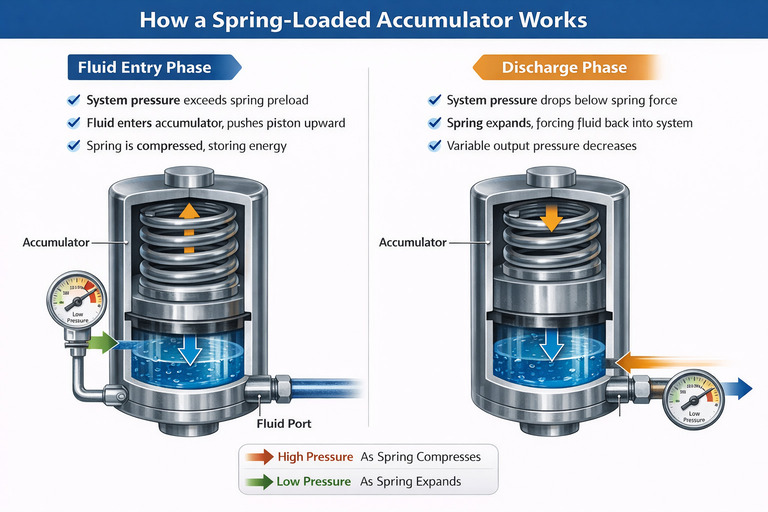
The operating principle is straightforward:
-
- Fluid Entry Phase
- When hydraulic system pressure exceeds the spring’s preload force, fluid enters the accumulator.
- The incoming fluid pushes the piston upward (or inward), compressing the spring.
- Energy is stored mechanically in the compressed spring.
- Discharge Phase
- When system pressure drops below the spring force,
- The spring expands,
- The piston forces stored fluid back into the hydraulic system.
- Fluid Entry Phase
Because the output pressure depends on spring compression, the pressure is variable, increasing as the spring compresses and decreasing as it expands.
Primary Applications
Spring-loaded accumulators are commonly used in:
- Pulsation dampening – Reducing pressure spikes from pumps
- Hydraulic shock absorption – Protecting system components
- Emergency power backup – Providing short-term energy in case of pump failure
- Leakage compensation – Maintaining pressure in closed systems
- They are particularly suitable for compact machinery and low-volume hydraulic circuits.
Limitations
Despite their simplicity, spring-loaded accumulators have practical constraints:
- Limited Volume Capacity – Large storage volumes require very large springs, which become impractical.
- Variable Output Pressure – Unlike gas accumulators, they do not maintain near-constant pressure.
- Size-to-Capacity Ratio – Energy storage per unit size is lower than gas-charged types.
- Higher Weight for Larger Units – Mechanical springs add bulk.
- For larger systems or higher pressures, gas-charged piston or bladder accumulators are generally preferred.
Comparison with Gas-Charged Accumulators
| Feature | Spring-Loaded Accumulator | Gas-Charged Accumulator |
|---|---|---|
| Energy Storage Medium | Mechanical spring | Compressed nitrogen gas |
| Pressure Output | Variable | More constant |
| Maintenance | Simple | Requires gas charging |
| Volume Capacity | Small | Medium to large |
| Typical Use | Small systems | Industrial/high-pressure systems |
Gas accumulators offer greater energy density and smoother pressure curves, while spring-loaded units excel in simplicity and compact low-pressure applications.